
You are in a coffee shop in the United States, holding Bitcoin in a mobile wallet while a bill or payment request arrives in Monero. The obvious solution seems simple: exchange one asset for the other inside the wallet and send the result. Yet the button labeled “swap” hides several separate systems—pricing, liquidity, blockchain settlement, identity checks, and privacy leakage. A fast in-wallet exchange can be safer and more convenient than sending funds to an unfamiliar exchange, but it is not automatically anonymous, trustless, or inexpensive.
The useful question is therefore not, “Does this wallet support anonymous transactions?” It is, “Which parts of this transaction are private, from whom, and under what conditions?” That sharper question changes how users evaluate a mobile crypto wallet. Privacy is not a single feature. It is a chain, and the chain is only as strong as its most revealing link.
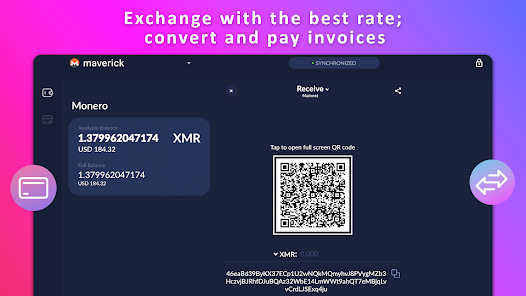
What an in-wallet exchange actually does
An exchange inside a wallet usually does not mean that the wallet itself is a global marketplace holding every asset. In many cases, the wallet presents a quote supplied by an exchange partner, swap service, liquidity provider, or decentralized protocol. The user selects the asset to sell, the asset to receive, and the amount. Behind the interface, the service calculates a rate, reserves or sources liquidity, executes one or more transactions, and returns the purchased asset to the user’s wallet.
That structure creates an important distinction between a wallet and an exchange account. A non-custodial wallet generally lets the user control the private keys, while an exchange account records a balance in a company-controlled system. In-wallet swapping can preserve self-custody before and after settlement, but the intermediate service may still observe an address, an IP address, a transaction amount, or information required for compliance. Self-custody reduces one category of counterparty risk; it does not erase every form of surveillance or operational dependence.
There are several ways an exchange can be implemented. A custodial or brokered route may be the smoothest: the provider accepts one asset and delivers another. A decentralized exchange may use smart contracts and pooled liquidity, although this model is more common for assets on compatible smart-contract networks than for native Bitcoin-to-Monero swaps. An atomic swap attempts to let two parties exchange assets through cryptographic conditions so that neither side can simply take the other’s funds. Atomic swaps can reduce trust, but they do not guarantee deep liquidity, low fees, or a simple mobile experience.
Bitcoin and Monero also differ at the protocol level. Bitcoin transactions are publicly visible, even when users employ fresh addresses and good operational practices. Monero is designed to obscure important transaction relationships through features such as stealth addresses, ring signatures, and confidential amounts. That does not mean Monero users are invisible in every context, nor does it make the act of acquiring Monero private by definition. A visible Bitcoin purchase followed by a Monero withdrawal may still leave a service with a clear record connecting the two events.
Myth versus reality: “in-wallet” is not the same as “anonymous”
Myth: A swap inside a privacy wallet is automatically anonymous.
Reality: The wallet interface may be private from one observer while the exchange path is visible to another. If a provider processes the swap, it may apply identity verification, transaction monitoring, geographic restrictions, or internal recordkeeping. In the US, users should expect that services can have compliance obligations that affect availability and privacy, especially when fiat payments, regulated intermediaries, or suspicious-activity controls are involved.
Myth: Monero makes the entire transaction history private.
Reality: Monero’s on-chain design protects specific transaction details more strongly than transparent ledgers do, but privacy also depends on the device, network connection, counterparties, and user behavior. A compromised phone can reveal wallet data. A reused contact method can connect transactions socially. A regulated service can know that a customer bought or withdrew an asset even if outsiders cannot inspect the same details on-chain.
Myth: Bitcoin privacy is achieved simply by generating a new address.
Reality: Fresh addresses are useful, but they are not a complete privacy strategy. Transaction amounts, timing, inputs, outputs, exchange records, and network-level information can contribute to attribution. Blockchain analysis is often based on combining clues rather than reading one decisive label from the ledger. A user who consolidates coins, sends a distinctive amount, or moves funds immediately after a known purchase may create a stronger link than expected.
For readers evaluating a mobile wallet, the practical lesson is to separate three privacy questions. First, what can be seen on the blockchain? Second, what can the wallet provider or swap provider see? Third, what can an outside observer infer from network, device, and behavioral metadata? A product may perform well on the first question and poorly on the second or third. Calling the whole process “anonymous” collapses these different threat models into a misleading slogan.
Convenience compared with control
The strongest case for an in-wallet exchange is convenience. Users avoid copying addresses between apps, opening a new account, waiting for a deposit to confirm, and withdrawing to a separate wallet. Fewer manual steps can also reduce address-entry mistakes. For someone managing Bitcoin, Monero, and other cryptocurrencies from a phone, a multi-currency wallet offers a coherent view of balances and a quicker response when a payment must be made in a different asset.
Convenience has a cost, however. A quoted exchange rate may include a spread, service fee, network fee, or liquidity premium. The displayed amount can change before execution if the market moves or if the transaction experiences slippage—the difference between the expected price and the final execution price. Smaller or less liquid assets usually face wider spreads and greater execution uncertainty. A swap that looks cheaper than a centralized exchange at first glance may not remain cheaper after all costs are included.
Centralized exchanges generally offer deeper liquidity, more advanced order types, and clearer trading records. Their disadvantages are equally concrete: users must trust the platform with funds, accounts can be frozen or restricted, and identity information is commonly collected. A direct wallet swap may reduce custody exposure but depend more heavily on a third-party quote and the wallet’s integration. An atomic swap may improve the trust model while sacrificing speed, liquidity, or ease of use. There is no universal winner; the appropriate route depends on whether the priority is price discovery, self-custody, privacy, or operational simplicity.
A helpful rule is to treat every exchange as a triangle involving custody, execution, and information. If a service improves custody by keeping keys with the user, it may still reveal transaction information to a swap partner. If it improves execution with a large centralized order book, it may require more identity data. If it maximizes privacy through a direct peer-to-peer mechanism, the user may accept more counterparty and settlement risk. Asking which corner is being optimized is more informative than asking whether a wallet is simply “secure.”
How to assess an exchange before pressing confirm
Start with the quote details. Look for the expected receive amount, the expiry period, network fees, service fees, minimums, and any slippage tolerance. Check whether the quoted rate is guaranteed or merely indicative. A wallet that clearly separates these costs is easier to audit than one that shows only a large “You receive” number.
Next, identify who executes the trade. Is the transaction handled by the wallet, a named partner, a decentralized protocol, or a peer? Does the provider require an account or identity verification? Can the user cancel before settlement? What happens if the outgoing transaction confirms but the incoming asset is delayed? These are not abstract questions. Cross-chain exchanges involve different confirmation rules, address formats, congestion patterns, and failure modes.
Then examine privacy at the edges. Avoid assuming that a private blockchain transaction protects information entered into a public website, linked email account, phone number, or exchange profile. Consider whether the wallet supports connection through privacy-preserving network tools, whether it logs analytics, and whether the user can verify transaction destinations before signing. These details may not be visible in a marketing screenshot, which is why a careful review of permissions and documentation matters more than a privacy badge.
For users deciding whether to install or evaluate a wallet, the cake wallet download resource can be a starting point for examining the mobile setup and supported workflow. It should not replace independent checks of the current app source, update history, recovery process, and exchange terms. Download authenticity is itself part of wallet security: a perfectly designed privacy feature cannot protect funds if the application or recovery phrase is compromised.
Security boundaries that privacy users often overlook
The mobile device is a major boundary condition. A wallet can use strong cryptography while the phone is rooted, infected, unlocked, or backed up insecurely. Screenshots, clipboard history, cloud backups, malicious keyboard applications, and social engineering can expose sensitive information without breaking the underlying blockchain protocol. A hardware wallet may be preferable for larger long-term holdings, while a mobile wallet can be practical for spending and smaller operational balances.
Recovery phrases deserve particular attention. Anyone who obtains the phrase may control the wallet, regardless of whether the original exchange was private. Store it offline, do not type it into websites or messages, and be cautious of support requests. Privacy-conscious users sometimes focus so heavily on chain analysis that they underweight ordinary account-takeover and malware risks. In practice, protecting keys is the first privacy measure because it prevents an attacker from converting private intentions into public transactions.
There is also a social limit to technical privacy. If a user sends funds to a merchant, exchange, employer, or friend who keeps identifying records, that counterparty may know more than the blockchain reveals. Privacy is relational: it depends on what each participant records and how separate observations can be combined. This is why “anonymous transaction” is usually better understood as a goal of reducing linkability, not a promise that no person or institution can ever connect activity to an identity.
What to watch as wallet exchanges evolve
If in-wallet exchange becomes more common, the meaningful improvements will likely be less about adding another token icon and more about making the route auditable. Users should watch for clearer fee breakdowns, better disclosure of liquidity sources, understandable privacy policies, transaction simulation, and stronger separation between wallet functions and third-party exchange services. These features would improve informed consent even when they cannot eliminate regulatory or technical constraints.
A conditional outlook is more useful than a prediction. If cross-chain liquidity improves and non-custodial settlement becomes easier, mobile wallets could offer more control without forcing users into multiple platforms. If compliance pressure or liquidity fragmentation increases, some assets may become harder to exchange privately, and users may face more verification or worse pricing. The signal to monitor is not the number of supported coins; it is whether a wallet explains who sees what, who controls which step, and what happens when a swap fails.
Frequently asked questions
Are transactions made through a mobile crypto wallet anonymous?
Usually, they should be described as privacy-enhanced or potentially less linkable, not guaranteed anonymous. On-chain privacy, provider records, device security, network metadata, and counterparty behavior all matter. Monero can conceal more transaction information on its own network than transparent ledgers such as Bitcoin, but buying, swapping, or withdrawing through a service may still create identifying records.
Is exchanging Bitcoin for Monero inside a wallet safer than using an exchange?
It can reduce custody risk if the user keeps control of the keys before and after the swap, but “safer” depends on the provider, quote, privacy practices, and device security. A centralized exchange may offer better liquidity and execution tools while collecting more personal information. An in-wallet route may be simpler but have higher spreads, fewer protections, or reliance on a third-party swap service.
What is the most practical privacy check before swapping?
Identify the transaction path. Determine who provides the quote, who receives the source asset, who sends the destination asset, what information is collected, and whether the exchange is custodial or non-custodial. Then compare the total cost and confirm that the wallet and phone are secure. This process will not make every transaction private, but it replaces vague trust with an explicit risk assessment.