
Most wallet failures do not begin with a stolen password. They begin with a transaction the user technically approved but did not truly understand. That is the counterintuitive problem in decentralized finance: the wallet may be working exactly as designed while the economic outcome is disastrous. A malicious contract, an excessive token allowance, a deceptive signature, or a mistaken network can turn a routine click into an irreversible transfer.
This is why risk assessment for a Web3 wallet cannot stop at asking whether it is non-custodial, open-source, or compatible with many chains. Those properties matter, but they describe the container rather than the decision process. The harder question is whether the wallet helps a user evaluate what a dApp is asking the blockchain to do before that request becomes final.
From address storage to transaction interpretation
Early crypto wallets were often treated as key managers: they held or connected to the cryptographic material needed to sign transactions. That model was useful when the main task was sending a native asset from one address to another. DeFi changed the workload. A single interaction can now invoke several contracts, move multiple assets, alter collateral, create a token approval, or expose a position to liquidation.
The practical result is that a wallet has become an interpreter between a human and a machine-readable request. The blockchain sees calldata, contract addresses, token amounts, and execution conditions. The user sees a button labeled “Swap,” “Deposit,” or “Confirm.” The security gap lies between those two descriptions.
Transaction simulation addresses part of that gap by estimating the state change that would occur if a transaction were executed. In a favorable case, the user can see which assets would leave the wallet, which assets would arrive, whether a balance would change unexpectedly, and whether an approval would grant broader spending authority than intended. This is more informative than relying on a dApp’s interface alone because the simulation focuses on the proposed on-chain effect.
That distinction is important. A polished interface can be compromised, misconfigured, or simply incomplete. A simulation is not a guarantee of safety, but it provides an independent lens on the transaction’s likely consequences. For a DeFi user, that changes the central question from “Do I trust this website?” to “Does the resulting state transition match my intention?”
Why simulation is powerful—and where it breaks
Simulation is best understood as a form of pre-execution testing, not a crystal ball. It runs a proposed action against an available representation of blockchain state. If the transaction would revert, unexpectedly transfer assets, or create a suspicious approval, the wallet may surface that before the user signs.
Yet the method has boundaries. Blockchain state changes continuously. A quote can expire, liquidity can move, and another transaction can be mined first. Some contracts depend on block timing, external data feeds, private order flow, or conditions that are difficult to reproduce perfectly. A simulation may also show what a transaction would do under current assumptions while the actual execution occurs under a slightly different state.
There is a second limitation: a technically accurate result can still be economically dangerous. A simulation might correctly show that a user receives a token, but it cannot by itself establish that the token is liquid, authentic, fairly priced, or useful. Nor does a successful simulation prove that the contract’s long-term governance, upgrade authority, or oracle design is sound.
This creates a useful hierarchy of confidence. First, ask whether the transaction is mechanically consistent with the intended action. Then assess the contract and protocol assumptions behind that action. Finally, consider market risk: slippage, volatility, liquidity, leverage, and counterparty or governance exposure. A wallet can improve the first layer substantially without eliminating the other two.
dApp integration is a security decision, not merely a convenience
Wallet-to-dApp integration is often discussed as a user-experience feature. In reality, it defines how much context survives the journey from a website to a signature request. A good integration should preserve the identity of the target chain, the destination contract, the assets involved, and the permissions being granted.
For US users moving between Ethereum and other EVM-compatible networks, chain confusion is a practical risk. Similar addresses, familiar branding, and rapidly changing network fees can make an action appear ordinary when it is occurring somewhere else. Network support therefore has two sides: broad compatibility expands access, while clear network identification reduces ambiguity. “Supports more chains” is not automatically safer unless the interface makes those differences legible.
Approvals deserve special attention. An approval does not necessarily transfer tokens immediately; it authorizes a contract to spend them later. That makes it a different risk category from a one-time swap. Unlimited approvals may be convenient, but they can enlarge the damage from a compromised or malicious contract. A disciplined workflow treats approval scope, spender identity, and revocation options as part of the transaction—not as technical fine print.
Signature requests are another boundary. Some signatures do not look like transfers and may not produce an obvious balance change at the moment of signing. They can nevertheless authorize orders, permissions, or off-chain actions that later affect assets. The familiar warning “never sign something you do not understand” is correct but incomplete. The operational improvement is to inspect what the signature authorizes, which domain it belongs to, and whether the request is consistent with the dApp session the user intended to start.
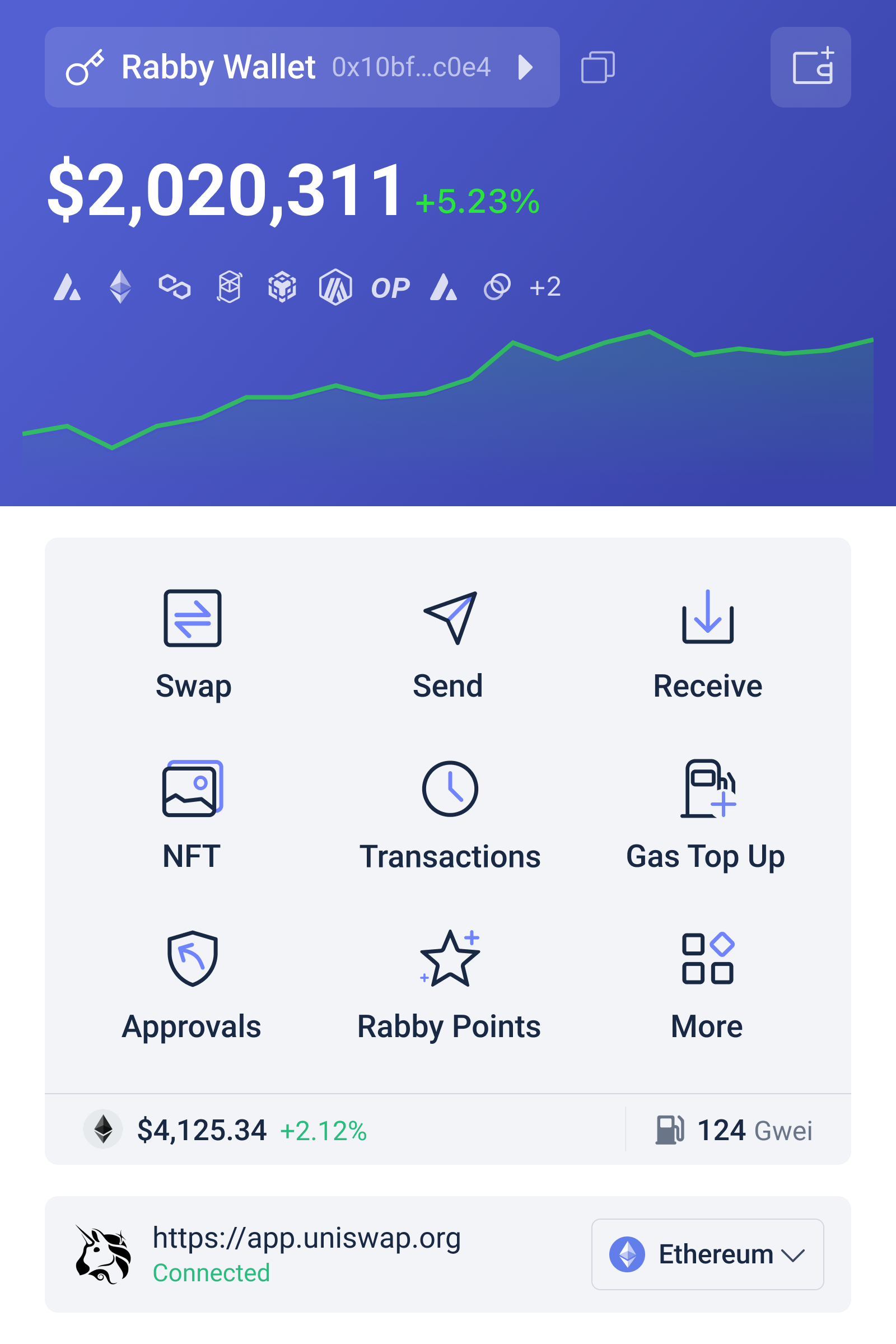
For readers evaluating an advanced wallet, rabby is worth considering in this specific context: not simply as a place to hold keys, but as an interface for reviewing EVM transactions, simulations, network context, and security warnings before approval. That does not transfer responsibility away from the user. It can, however, make the relevant evidence easier to inspect at the moment when judgment matters.
A reusable risk-assessment framework
A practical framework should be short enough to use under real conditions. Before approving a consequential dApp action, separate the request into four questions.
- Identity: Is the dApp, contract, chain, and wallet account the combination you intended to use?
- Effect: What assets, permissions, or positions will change if the transaction succeeds?
- Exposure: What is the maximum plausible loss if the contract, approval, oracle, or market behaves badly?
- Reversibility: Can the action be undone, revoked, or exited without relying on the same system that created the risk?
The fourth question is routinely neglected. Sending a transaction is often irreversible, but the consequences are not always equally permanent. A limited approval may be revoked. A leveraged position may be closed, although not necessarily at a favorable price. A bridge transaction may create delays and additional dependencies. Thinking in terms of reversibility helps distinguish a small operational error from a risk that can cascade across protocols.
This framework also exposes a common misconception: wallet security is not a binary property. It is a layered control system. Hardware signing can protect private keys from some forms of malware, but it cannot determine whether the user is approving a bad contract. Simulation can reveal an unexpected transfer, but it cannot validate a protocol’s economic model. Human review can catch contextual errors, but fatigue and urgency weaken it. Security improves when these layers cover different failure modes rather than duplicating the same defense.
What current wallet design should be judged on
Recent wallet messaging emphasizes Ethereum and EVM coverage, speed, simplicity, and security. Those goals are compatible only up to a point. Speed encourages fewer interruptions; security often requires more explanation. Simplicity removes clutter; accurate risk disclosure sometimes demands detail. The strongest design does not pretend this tension disappears. It gives users a fast path for familiar, low-risk actions and a more demanding review path when approvals, unusual contracts, large balances, or complex calls are involved.
That suggests a more useful benchmark than feature counting. Ask whether the wallet increases the quality of the user’s decision. Does it distinguish a transfer from an approval? Does it show the likely net asset change? Does it flag a mismatch between the dApp’s apparent purpose and the contract behavior? Does it make chain and account context prominent? Does it help the user understand failure rather than merely displaying a generic warning?
These are difficult product questions because warnings can become background noise. If every interaction is labeled dangerous, users learn to dismiss the interface. If warnings appear only for obvious failures, subtle attacks pass through. The unresolved design challenge is calibrated friction: enough interruption to slow down a risky decision, without training users to click through every alert.
The likely direction of the category is conditional rather than guaranteed. If wallets can improve simulation accuracy, explain permissions in plain language, and reduce false alarms, they may become active security layers rather than passive signing tools. If users treat simulations as automatic approval badges, the same features could create misplaced confidence. The signal to watch is not how many warnings a wallet displays, but whether users can correctly connect those warnings to the economic consequences of their actions.
Frequently asked questions
Does transaction simulation make a dApp safe?
No. It can reveal likely execution effects and catch some failed or unexpected transactions, but it does not prove that a contract is trustworthy, that an asset is valuable, or that a protocol’s governance and economic assumptions are sound. Treat simulation as pre-execution evidence, not a security guarantee.
Why are token approvals a separate risk from swaps?
A swap usually attempts to exchange assets in one transaction. An approval grants a contract permission to spend tokens, potentially in later transactions as well. The practical risk depends on the spender, the allowance amount, and whether the permission can be limited or revoked. Reviewing approvals separately prevents users from confusing authorization with immediate settlement.
What is the most useful wallet habit for DeFi users?
Before signing, compare the intended action with the simulated state change: the chain, contract, assets leaving, assets arriving, and permissions granted. If any part is unclear, pause rather than treating a familiar dApp name or polished interface as evidence of safety.
The mature view of a Web3 wallet is neither “a vault that solves security” nor “a thin window onto the blockchain.” It is a decision-support system operating at the most consequential point in the workflow: immediately before an irreversible instruction is signed. Its value depends on how faithfully it translates machine-level execution into human-level consequences—and on whether the user remains willing to question what the screen is showing.